Thursday, December 6, 2012

sixty-four feet thick

This past weekend, I went down to the district of Chiure to spend some time with a new church plant in the village of Marera.  We spent Saturday hanging out with church members and walking around a little bit. I was surprised to see many more spirit houses (places where those possessed by evil spirits practice their devotions or do divination) than I had ever seen in one village. Saturday night we showed the Jesus film, though unfortunately the speakers stopped working about 10 minutes into the movie.  To my amazement a couple hundred people stayed and watched this silent film all the way to the end.


I woke up on Sunday morning before 5 am to a small group of people staring at me, coming up to greet me even before I was fully coherent.  We walked down to the river where 50 people from this village were baptized - older men and women, young adults, and a bunch of young people.  It was the most baptisms I've ever seen in one place.  While the baptisms were happening a number of the young people were singing and dancing.  At this part of the river all sorts of people from the village were present. Some were washing clothes or taking baths, some of them paying attention to this strange ceremony while others ignored it completely.  I noticed an Islamic leader smiling as he watched the baptisms.  I left the crowd and went and to stand by this man and we chatted some as I asked him what he thought of all this commotion.  

After worshiping together back at a new mud brick and sparsely thatched church building, we ate, said our goodbyes, loaded up, and left down a bumpy road and through a dry riverbed.  A number of people from nearby churches had walked, biked or ridden motorcycles to get there.  Those from farther away hitched a ride home with me.  Jeremy and I have been coming to Chiure for the past 5 or 6 years working with mostly the same group of 10-15 men.   And some of those men have been discipling Eugenio and Cabral (church leaders from two different villages, men that I know but have not been discipling directly). And now here these guys, discipled by men we've been discipling, are working together to make disciples in a new village.   That was the most exciting take away for me from this weekend. 

 As we bumped along the road, we talked about the ways that churches in this district have really been growing.  And then I joked (or maybe lamented!) that back in the district of Montepuez, 50 people would be enough for 2-3 churches.  For a number of reasons - some I think I understand and others I do not -  the church growth has been painfully slow in certain areas.  For example, just two days later, when I stopped in to see our friend Londres on Tuesday, one of the 3 remaining church members in the village of Namwaciko... he was totally drunk. 

How do we persevere when the work can seem so painfully slow in some places while in other places things seem to be moving? How should we understand that?

In his book, Christ Plays in Ten Thousand Places, Eugene Peterson tells the story of Rick Bass.  Whenever Bass was confronted with a difficult problem, he used to imagine himself laying bricks, one by one, slowly, until the job was done.  But now he sees his work through the image of a glacier.  "A glacier is the most powerful force the world has ever seen.  Nothing, literally nothing, can stop a glacier.  A glacier is formed by the falling of snow that accumulates over a period of time - an inch today, a quarter of an inch yesterday, a mere skiff of powder last week.  As the snow deepens, the weight compresses. Ice is formed, and then more snow, which becomes more ice, year after year after year. Nothing happens for a long time, but when the glacier is sixty-four feet thick it starts to move, and once it starts nothing can stop it."  
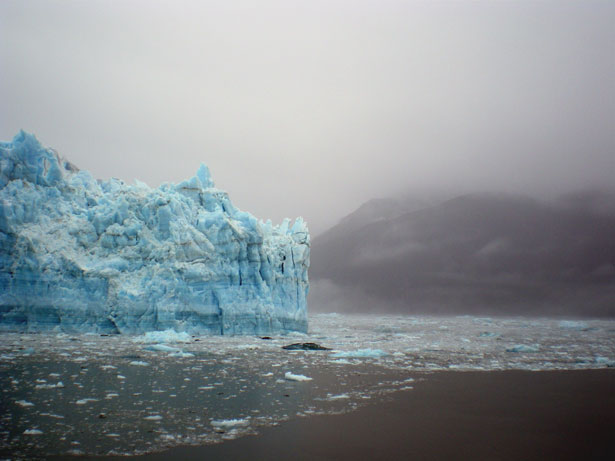
Icy Straits Glacier
Bass talks about one theory of how glaciers are formed.  He says that some believe glaciers are "the result of a wobble, a hitch, in the earth's rotation...glaciers get built or not built, simply, miraculously, because the earth is canting a single one-trillionth of a degree in this direction for a long period of time, rather than in that direction."  Bass says that when he is discouraged and feeling "kicked all over the place, I tell myself that little things matter - and I believe they do.  I believe that even if your heart leans just a few degrees to the left or right of center, that with enough resolve, which can substitute for mass, and enough time, a wobble will one day begin, and the ice will begin to form, where for a long time previous there might have been none.

"Keep it up for a lifetime or two or three, and then one day - it must - the ice will begin to slide."

This image has sustained me over the past few years.  It has been helpful to imagine our daily efforts among the Makua-Metto as an inch or two of snow here, a little bit of powder there, little by little accumulating until it reaches a critical mass and begins to slide.  In some places the glacier is forming quickly built on years of work and prayer by others, while in other areas I wonder if it won't take generations before the glacier is ready to move.  In either setting, our calling is the same, contributing a little more snow - trusting that one day the ice will begin to slide.

Anyone else out there with a metaphor that helps you keep going? 

Grace and Peace,
Alan

Friday, November 30, 2012

What Pixar taught me about...Evangelism & Discipleship


At one point in the film Ratatouille, the main character shares with his father his dream of being a chef.  As they talk it is immediately clear that this idea is in conflict with the dad's desires for the son to be part of and serve the interests of the family (the dad is the head of the rat clan).  The son says, "You didn't think I would stay forever. Eventually a bird has got to leave the nest" And the Father replies, "We're not birds, we're rats - we don't leave the nest, we just make the nest bigger."

This scene comes to mind when I think of evangelism and discipleship.  It is no secret that in this post-modern world people are more cynical and skeptical about religion.  Many assume that religious people are trying to "sell them something." They imagine all sorts of ulterior motives - "you only want me to join your group in order to serve the interests of your institution through time, talent and treasure - you just want to make your nest bigger."

This is in contrast to the patient evangelist/disciple maker whose goal is to see that person come alive in whatever context best suits them.  Now, often times that will be a part of the evangelist's own church tribe, or it may be that because of the new disciples' situation or other relationships he or she is a better fit in a different church tribe or nest.

Jesus modeled this kind of generous approach.  He didn't rush people into making a decision (think of the Samaritan woman at the well - John 4).  He didn't expect them to follow him to his own context (the man healed of a demon was told to stay and witness to his community - Mark 5). He didn't discourage people from other groups from doing good in his name (Mark 9).  And he didn't accommodate their faults in order to make his nest bigger (wouldn't the rich young ruler have been a nice status addition to the group of disciples? - Luke 18).  Instead Jesus prodded and poked and challenged people to enter into the Kingdom of God.  Jesus didn't focus his energy on making his own nest or tribe bigger - instead he saw the Kingdom as the ultimate reality that he was working for and towards. 

Here in Mozambique we sometimes encounter people who are interested in following Jesus, but  because of certain factors it wouldn't make sense to expect them to be part of our own 'nest.'  Maybe they live a great distance away and there is another church tribe closer to them, or it could be that they have important family connections within a different church tribe.  We need to be attentive to the their life situation, focusing on what kind of environment will be best suited for their thriving. We are called to sow and water, not necessarily to transplant.  The process of transplanting is risky for both the health of plants and people.

Our goal in evangelism and discipleship will ultimately become clear to those we are with.  At some point they will know whether we are in it for their own good - their own flourishing, or if we are just trying to make our nest bigger - getting them to serve the interests of our institution.

The true goal of evangelism and discipleship is much better and more expansive than "us having bigger nests."  Our goal should be to help people become the creatures they were created to be.  Often that may mean they become part of our tribe, but it may mean they will spread their wings and fly building up a different nest.  But, if we have been faithful with the opportunities we've been given to encourage and mentor, then the ultimate goal of seeing God's kingdom rule expand will be served.

At the end of the film, the head of the rat clan is convicted of the need to help his son realize his calling and he mobilizes the entire clan to help the son succeed.  My hope is that the communities we are working with will be generous in helping people fully use their gifts, even if it may not 'benefit' our own tribe.

May our ventures in evangelism and discipleship be focused less on building up our own nests and more on seeing people become who God created them to be and further the Kingdom of God. 

Peace,
Alan