Saturday, June 29, 2013

Harry Potter and the remedy for culture shock


While Rachel and I were in language school in preparation for our move to Mozambique, one of my favorite ways to increase vocabulary was by reading.  The Harry Potter series in Portuguese was an especially fun way to practice because the story kept my attention.  (Also I didn't expect it, but all that sorcery vocabulary has actually come in handy here!).  So, in our first few years away from the USA, I would keep plugging away, slowly working my way through J.K. Rowling's bestselling series in that language.


Since I was reading those books early in my time overseas, I have tended to associate them with culture shock.  Missionaries and expats talk a lot about this topic.  For those of you unfamiliar with this term, culture shock has to do with the disorientation experienced when living in a new and radically different environment.  You feel tired all the time and the press of a new language and culture leaves you feeling drained of anything good and life giving.


So, the best description of culture shock that I can give you is this: culture shock is similar to the Dementors from the Harry Potter series.   The Dementors are these single-minded wraiths who chase after their prey with the goal of sucking out one's soul.  Both culture shock and the Dementors are destructive forces that when left untended can render the person helpless.


In the series, after encounters with the Dementors, Harry and his friends are always given chocolate to help recover their strength.   So again, we have another similarity between culture shock and the Dementors.  While there is no complete cure (no method to drive them away forever), the closest thing that comes to an antidote for the symptoms of either of them is of course... chocolate!


So, my advice for new missionaries experiencing culture shock: If at all possible, keep your pantry well stocked with chocolate.


And if your church is supporting a new (or even a not-so-new) missionary - now you know what to put in their care package :) .


Grace and Peace,

Alan

Friday, June 28, 2013

where the pavement ends


The pavement ends a couple hours drive west from the capital of Cabo Delgado right here in the town of Montepuez.  Our mission team lives here in order to help develop a network of churches among the Makua-Metto people spread out in rural villages throughout this region.  There are few cars or trucks on these roads, so our visits to these villages usually include bringing people we are discipling along with us as well as blessing the sick and their families there with rides to the hospital.   
 
We often end up helping people bring some of their crops to market here in town.  And we are often called upon to transport the bodies of people who have passed away here in the local hospital so they can be buried near their kin. 


Having a reliable vehicle here in Mozambique has allowed us to bless many people. But now that we've been in Africa for close to ten years, our aging truck has had more and more problems.  Between the bad roads and the lack of quality parts available locally, it has become increasingly difficult for each of the families on the team to keep their vehicles up and running.


Driving back home on Tuesday, for example, our truck's radiator started leaking and we had to limp our way to Montepuez driving slowly through a very remote part of the country.  Yesterday, a friend and I took out the radiator, cleaned it and welded shut the hole.  So for now our vehicle is back up and running again, but it's certainly showing its age. 


As I've written elsewhere about our aging truck and how keeping it running has been more of a challenge lately, our friends from the Donelson Church in Nashville and the New Heritage Church in Allen, TX have joined forces to help us raise funds for a new vehicle.  Here is a link to a video they've made showing road conditions in Mozambique and why it is important for us to have a reliable vehicle.


Good quality used vehicles are almost impossible to come by.  And because of a 100% import tax on double cab trucks like the one we use, the cost for a new Toyota truck, comparable to a Tacoma is (gulp) around 47,000 dollars.  If you are interested in helping out with this effort, please make checks out to the "Donelson Church of Christ" with "Mozambique Truck Fund" in the note section and send them to: 2706 Old Lebanon Rd. Nashville, TN 37214. 


Thanks for keeping up with this ministry and keeping us in your prayers.


Grace and Peace,

Alan and Rachel

Wednesday, June 12, 2013

the 10 books I wish I had read before moving to Africa


Back in March, we celebrated the 10 year anniversary since leaving the United States.  That has made me a little extra reflective lately, so I tried to put together a list of the top 10 books I wish I had read before moving to Africa.  Wow - that was hard... but here they are in no particular order.

Enjoy!

Alan 


Thursday, June 6, 2013

On hearing it here


In an excellent talk for ministers, Dr. Ben Witherington III explores the impact of orality and rhetoric in the time of Jesus.  While the US culture enjoys and assumes a high rate of literacy, Witherington says that the literacy rate in 1st Century Palestine was probably only 10-15%.    So, it is significant that Jesus did not say, 'let he who has two good eyes read,' instead he said 'he who has ears, let him hear.'  The letters of Paul, for example, were intended to be read aloud in the churches. 
   
The Bible was written to be heard - it is to be an oral text.

While many today equate the 'word of God' with the written text of the Bible, Witherington says that is not the way the phrase was used in the New Testament.  The phrase 'word of God' refers to either Jesus Christ (John 1) or it refers to the oral proclamation of the good news about Jesus (1 Thess. 2:13).  The 'word of God' didn't refer to a static written text, it referenced the proclaimed message - the heard Word.  

The Makua-Metto people also have an oral culture.  Low levels of literacy create significant challenges.  From a census of the Churches of Christ in Cabo Delgado conducted last year, we found that out of the over 1100 members, less than a third of them can read at all (that percentage follows pretty closely the literacy rate for the population as a whole).  Out of that group though, only 16% said that they could read well.

One way that we are trying to address this problem is to use audio players so that church members can listen to God's word with their families and neighbors.  With contributions from a few of our friends (thank you so much - you rock!), our team was able to purchase 100 DAVAR players.  They are solar powered and easy to use.  We were able to put recordings of 125 songs in Makua-Metto (thank you Chad), recordings of the books of Mark and James (thank you SIL), the 'Look, Listen and Live' series of Bible stories (again thanks SIL), and a bunch of sermons and lessons for adults and children in Makua-Metto (thank you Aguas Vivas Ministry, Balama).

In the Makua-Metto language, the word for 'hear' or 'understand' is 'wiiwa,' while the word for 'obey' is 'wiiwelela.'  These two words are connected linguistically, as the word for hearing or understanding serves as the base word for the concept of obedience.  This language connects these two actions in our friends' minds.

It has been fun distributing these audio players to our friends here in Cabo Delgado.  Our hope is that through the church and these audio players, more and more people will encounter the heard word of God - that they would both 'wiiwa' and 'wiiwelela.'

May the Makua-Metto people hear, understand... and obey God's word!

Grace and Peace,
Alan

Tuesday, May 28, 2013

What can a reformed pirate can teach us about suffering?


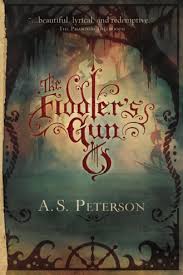
"Near the beginning of A. S. Peterson's fictional novel, The Fiddler's Gun, a reformed pirate and two young orphans have an interesting discussion about pain and suffering. They open up a wooden case revealing three objects: a fiddle, a bow and a pistol. After examining each of the elegantly crafted items, the former pirate tells them,


'"Now, see here, you got to put that hurt someplace, and this is where old Bartimaeus learned to put his." He lifted the fiddle out of the case and caressed it. 


"It's beautiful," whispered Fin. 


"Aye," he said and crooked it into his neck. He drew the bow across the strings and the instrument moaned a forlorn note. "Beautiful, that's what you've got to do with that hurtin', you got to turn it beautiful." (p. 33)


... '"What's the gun for?" asked Peter.


Bartimaeus' face darkened. "That's where all that hurtful stuff ends up if you don't get rid of it. Got to get rid of it. You don't and it might just get rid of you, see here? I keeps it there to remind me. I put it down the day I got this fiddle. Swore I would never take it up again. Done too much hurtin', got to turn that hurt to beautiful, see? Otherwise the hurt turns hateful and the ole hand-cannon there like to wake up and do terrible things...terrible things." (p. 34)


This fictional conversation illustrates well the stakes involved in possessing an effective response to pain and suffering. We all end up doing something with our pain.  If we cannot frame suffering in an instructive or constructive way, it will become destructive - harming those around us as well as ourselves.


For close to ten years in northern Mozambique I’ve witnessed the effects of mis-appropriated pain: family members become isolated, people live in fear, neighbors are cursed, and there is no rest. Years ago, as we first began to learn the language and culture of the Makua-Metto people, there was one word that I was surprised to hear over and over again in conversation: 'uhuva'. It’s their word for suffering, and our friends talk about it  all the time.


The problem is that their folk religion does not give them tools to deal with suffering constructively. The majority of the Makua-Metto people would consider themselves Muslims, but at the core they are shaped by an animistic worldview. This folk religion binds them and their pain to a witchcraft system crammed full of curses, counter curses, spirit possession and divination. To borrow language from the fictional conversation above, they lack the ability to take their suffering and "turn it beautiful."


Coming from my American cultural framework, I slowly came to the realization that their primary question is not "why" this suffering happens. Instead, they consistently personalize the evil they experience. They want to know "who" did this to them. Their quest to determine the identity of the culprit leads them into divination, which, when indicating a human target, encourages them to reach for that "ole hand-cannon" - directing all that pain and anger at another. Human beings must do something with their suffering. If they are unable to do something constructive, or interpret their suffering in a way that is instructive, then they ultimately will do something destructive.


As an American I could see that there are different ways to pick up the “gun”. Generally those in my home culture tend to turn this destruction inwardly. We self-medicate with drugs, escape into television/film, experience depression or practice self-mutilation. This contrasts with my experience with Africans, who when unable to do something good with their suffering, generally tend to turn the 'gun' on each other. It seems that this orientation affects the way both cultures approach scripture as well. The American Christian will focus on texts about personal sin and forgiveness (internal), whereas the Africans I know are more likely to concentrate on texts about suffering, deliverance, and protection (external)."


----


The above quote is an excerpt - if you are interested in reading more about responding to suffering - and specifically how that plays out here in the context of northern Mozambique, please check out my recent article, "Turning it Beautiful: Divination, Discernment and a Theology of Suffering" in the International Journal of Frontier Missions here.


Grace and Peace,

Alan