For this newsletter we wanted to share with you one example of a day can be like here in our corner of the world - enjoy!
 On Fridays I go visit and study through Jesus’ Sermon on the Mount with some women I love north of town, alternating Fridays between the village of Newara and the village cluster of Chipembe/Omeringue/Nkunama. Friday January 20th I got up early because I was going to Omeringue. I had packed my backpack the night before to save time – I have the scriptures in Makua and in Portuguese, my own drinking water and toilet paper for the day, vitamins to share with my friends (a frequent request), a few pieces of candy for their kids, and a couple empty sacks, since they never fail to send me home with corn flour or mangos or cassava or beans.
One of my friends from Chipembe had gotten a ride with me back into town two weeks earlier (January 6th); her name is Juliana and the church in Chipembe worships at her house. She has a lot of health problems, and was scheduled to get an injection at the hospital in Montepuez on January 17th. Even though getting a ride on the 6th was way earlier than she needed to come, it was a free ride and she knew I wouldn’t be back in Chipembe again until the 20th, after her scheduled appointment at the hospital. When she is in town she stays with her mother Filomena, who has a house in one of the large neighborhoods in Montepuez (when I say neighborhood, you need to picture thousands of mud huts with grass roofs all close together, with narrow mud paths between, and limited mud paths wide enough for cars to pass). Juliana had polio as a teenager and can’t walk without a long walking stick, but even then her legs are so wasted and twisted that she really can’t go far, so we had agreed that I would go get her at her mother’s house early that morning, and then we’d leave for Omeringue together.
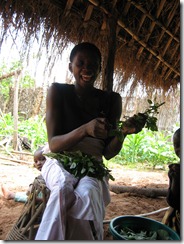 I had only been to her mother’s house in Montepuez once before; I was mostly confident (and only a tiny bit doubtful) I could find it again (many of the mud huts look exactly the same, and here in town they are often on a grid, which can make it tricky remembering whose house is whose.) Unfortunately, soon after entering the neighborhood I came upon a huge, old mango tree that had fallen across the path in the strong winds the night before. At this point it’s about 7:15 a.m., and I was still so far from Filomena’s house that I knew they probably didn’t know about the tree that was blocking my path to reach them. A crowd of people had gathered around the fallen tree all discussing what should be done about it and how it should be done, but I knew that the tree wouldn’t be moved in time for me to get through that morning.
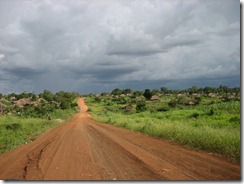 So I was stuck there with the truck and a crowd of strangers staring at me while I tried to decide what to do. I told a few folks standing around that I was trying to go get my friend because she can’t walk and we were going somewhere together, and they tried to help me find an alternate path, but none were wide enough, and I wasn’t confident enough of my knowledge of the neighborhood to go blundering around with truck and get lost in the maze of mud huts (it is a big neighborhood) or get stuck in the mud somewhere. So I locked the car and started walking, following the path I knew to get to Filomena’s house, all the while hoping (and mostly sure) that I was on the right road. After about twenty minutes of walking, a lady that I had seen way back near the fallen tree calls out to me from about six houses away “Hey, you’re going the wrong way; I found your friend you’re looking for!” So because of that tiny seed of uncertainty in my knowledge of that neighborhood I turned off down a different path to follow her, and we walk together for about 15 more minutes. She took me to a house that I didn’t recognize, and said “here’s your friend that can’t walk!” And there was a lady in the yard who couldn’t walk well, using a walking stick, with legs wasted from polio, but it wasn’t my friend Juliana, and it wasn’t Filomena’s house…
So I left, slightly annoyed – not at the lady who had tried to help me but at myself that I hadn’t stuck with what I had been mostly sure was the right path. The helpful lady walked with me, which was kind, and we backtracked to the path I had been on, and, to keep me humble, we discovered I had only been about four houses away from Filomena’s house when I had been called away! Juliana was waiting, and her children ran up to hug me, and together with Filomena and some more of her children we all laughed about how late it was and about my adventures trying to get to them that morning.
As we began picking up small children and all Juliana’s things to walk back to the car, she mentioned that she actually hadn’t gotten her treatment at the hospital yet. She went on the 17th, the scheduled day for the injection, and was told they were out of that medicine and to come back the next day because they were sure they’d have it then. She went back on the 18th, and again on the 19th too and was turned away each time, but the people at the hospital were of course very confident they’d have the right supplies the next day on the 20th. Another thing to understand about life here is that there are always a couple hundred people at the hospital’s clinic every morning, often waiting hours to be seen, so at this point I’m shaking my head and wondering what else is going to happen that morning to keep us from getting on the road to Omeringue.
We loaded up Juliana and her children and her parcels of food and clothing into the truck and drove to the clinic, and I waited out front and called Alan to explain why it was 8:30 and I hadn’t even left town yet. I was expecting a long wait, but surprisingly (and thankfully!) Juliana had asked the people in line if she could slip in at the front of the line, and (also surprisingly) they let her, and she was back in the truck in less than ten minutes, and we got on the road to Omeringue.
 The road north is the least-travelled road out of Montepuez, and the rains had beat down hard on it those past two months, leaving lots of mud, deep puddles up to the width of the road, and other places where fast-draining rainwater has washed away half the road, leaving a very small space to pass by the gaping holes. Driving to Chipembe usually takes about 45 minutes (about 16 miles), with another 5-10 minute drive to Omeringue. We pulled into Chipembe with lots of mud splashed up on the truck, and Juliana got out to put her things away, and I walked to the house of another friend Hajira, to tell her we’d arrived and were ready to go to Omeringue. I went to say hi to the wife of the chief of the Chipembe, and she asked if I had room for some passengers when I returned back to Montepuez that afternoon, so we agreed on a spot where I would pick them up later that day. Hajira and Juliana got in the car, and four of their children with them, and we drove a few more minutes to Omeringue.
 There is a broken bridge just before Omeringue, but the part of the bridge that remains intact is just barely wide enough for the wheel base of our truck, so we can cross, but it still makes me a little nervous. Laurentina and her daughter Benedita were waiting for us, and we all greeted each other and chatted for awhile while a small crowd of children from Omeringue gathered to watch (a white woman speaking Makua is a strange sight); they especially enjoyed hearing the story of why we were so late leaving Montepuez that morning. There was a funeral going on for another family in Omeringue that morning; a young mother had gotten sick with a virus and severe diarrhea and had been taken to the hospital in Montepuez and died there. Laurentina pointed out a couple of the neighbor children who had gathered as the children of the woman who died, the youngest of which still didn’t believe that his mother had died and was still claiming that she was in Montepuez. Two of the six women from that church cluster who usually study with us did not come that day; Elisa and Elena from Nkunama were out working in their farm because they have a serious problem with baboons coming and stealing seed and crops.
 After about an hour of fellowship and conversation, we sang a few songs and prayed together and opened up Jesus’ Sermon on the Mount. That day we studied Matthew 4. 21-30, which includes the section where Jesus puts hate and contempt at the same level as murder, and lust at the same level as adultery, as well as the sections on prioritizing forgiveness over religious ritual and humbly resolving disputes with a neighbor before it gets out of hand. Of these six friends, only two can read, Juliana and Elena, and only Juliana was there that day. So we take a more oral approach when we study together; I read the passage aloud two or three times, and then I go back and read it phrase by phrase with them repeating each phrase, and we end up covering the same passage up to seven or eight times so it really sinks in.
 Some of the content that day was pretty straightforward; when Jesus said anger, contempt, and insulting someone are the same as murder in the heart of the perpetrator, while provocative it’s not hard to understand what he’s getting at. Other sections, though, were trickier – Jesus didn’t really mean for his listeners to cut off their hand if it caused them to sin, but he was trying to show that you could cut off lots of body parts and still have evil in your heart, and that it is what is in our hearts is the true cause of sin and selfishness.
We talked for a long time about what we had heard; I mentioned that Jesus is calling us and teaching us to go beyond actions (not killing anyone) to having hearts that love (not insulting or having contempt), which of course takes care of the actions, too (without contempt there is no murder, without lust there is no adultery). The longest discussion that day was about adultery; three of the women shared how they used to sleep around, but that since beginning to follow Jesus they hadn’t done it since. The fourth woman (who has been a Christian the shortest amount of time) joined in the discussion pretty freely saying she had done that some but didn’t realize she wasn’t supposed to, and the other women encouraged her to stay faithful to her husband.
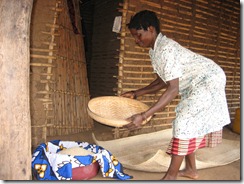 After we finished discussing what we’d heard, we prayed for each other and then Laurentina went and finished cooking lunch. We ate xima and matapa; xima is a stiff porridge made of corn flour, and matapa is whatever you eat with that, which that day was two different types of greens – leaves from the cassava plant and leaves from bean plants. We made plans for the Friday two weeks from then to come to Omeringue, leave the car, and walk to Nkunama since it is so difficult for Elisa and Elena to get away, and the road isn’t passable by car this time of year.
One of Laurentina’s grown sons wanted a ride into Montepuez that day, and when I asked if it was just him, he said he wanted to take two goats with him to sell. So he tied the legs of the goats and got them into the back of the truck with help from a friend. The road back to Montepuez, of course, didn’t get any smoother on our return trip, and the goats screamed at nearly every bump in the road. If you’ve ever heard goats bleating loudly in protest, you know that they can sound eerily like a person who is very incoherent but crying and wailing really, really loudly. One other older man from Omeringue asked for a ride into Montepuez, and in Chipembe we picked up the three passengers (school teachers) who needed a ride.
 Returning on the muddy roads that afternoon with our screaming goats, we came upon a truck stuck in the mud. The truck belonged to the large cotton company in Montepuez, but the driver that day had decided to blaze a new trail through the soft mud on the edges instead of straight through the middle of the puddle, and he was really, really stuck. Up until that day I had always let Alan be the one to use four-wheel drive; I’ve had a weird phobia of getting the truck stuck in the mud and not being able to get out. So that day was my first time to go into four-wheel drive to try to pull the other vehicle out, but unfortunately we weren’t successful! I left our tow strap with him before I left, and thankfully about ten minutes down the road I saw a tractor on its way to pull him out. (With all the rain we’ve had since that day I’ve had a lot more practice using four-wheel drive!)
 Back in town I dropped off the passengers (and the screaming goats!) at a few different places, and headed home; it wasn’t long before the guy from the cotton company came to return our tow strap as the tractor had successfully pulled him out of the mud. I always really miss my girls after being gone all day, and it’s fun to come home to them and be greeted by squeals and hugs!
Thanks for taking the time to hear about what a day here can be like! For those who’ve asked us, “What’s a normal day like for you guys?”, now you’ve got a glimpse!
We miss you when we are far away; and we are very much looking forward to furlough in a few months!
Much love and peace to you!
Rachel and Alan Howell
 Our
sponsoring congregation, the Donelson Church of Christ, is going through The
Story (check it out at TheStory.com). The church as a whole is using this material
to study through the main events of the Bible to better understand God's Story
and what it means for our stories. Before we finished up our furlough and left
Nashville to began our journey home to Mozambique, Brian Oliver handed me a
copy of the The Story for Children by Lucado, Frazee and Hill. It is has terrific artwork and well crafted chapters. I was pumped because it was going to be my
turn to teach the Bible class for the kids and now I knew what we could use
with them every Tuesday night for the next few months.
Our
sponsoring congregation, the Donelson Church of Christ, is going through The
Story (check it out at TheStory.com). The church as a whole is using this material
to study through the main events of the Bible to better understand God's Story
and what it means for our stories. Before we finished up our furlough and left
Nashville to began our journey home to Mozambique, Brian Oliver handed me a
copy of the The Story for Children by Lucado, Frazee and Hill. It is has terrific artwork and well crafted chapters. I was pumped because it was going to be my
turn to teach the Bible class for the kids and now I knew what we could use
with them every Tuesday night for the next few months. 


